
To Download Datasheets Select Below and Click Download
-
Download TDS Datasheet
pro-bond 20FG2: Non-reinforced Hydrocarbon Material
UL Approval: E214381 09/08/2024General Information
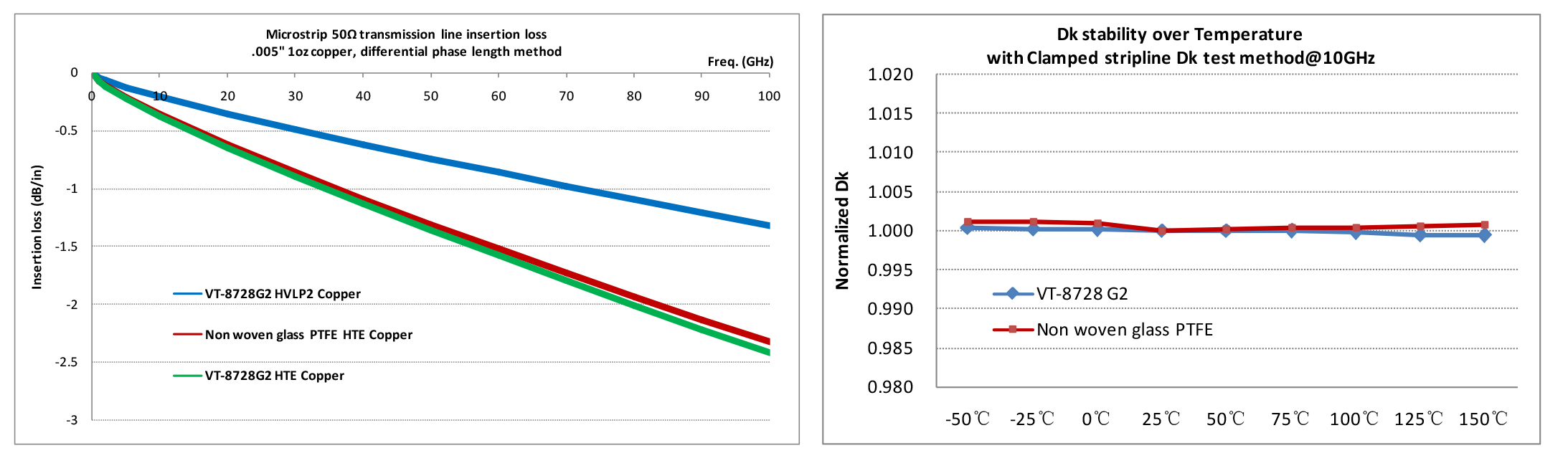
VT-8728G2 RCF is non-reinforced hydrocarbon material, which eliminates the skew and variation in high speed digital and RF application with extremely low loss property (Df 0.0011@10GHz). It is designed to bond all circuit board materials and is more friendly to PCB process because of the thermosetting resin system.
- Controlled resin flow for varient application
- Excellent through hole reliability
- Non-glass fabric reinforced, excellent electrical isotropic consistency
- Stable Dk over temperature
- Friendly for laser drill process
- Suitable for sequential laminations
- Halogen Free
Application
- Avionics & Aerospace
- Radar & Sensors
- Antennas
- Filters, Couplers
Storage Condition
Properties Prepreg Storage Condition Temperature Below 23˚C (73˚F) Below 5˚C (41˚F) Relative humidity Below 55% RH / Shelf Life 3 Months 6 Months Designation of RCF
Trade Name Name Specification Description pro-bond 20FG2 VT-8728G2 RCF 8728G2-FT L-050 pro-bond 20FG2 (VT-8728G2 RCF) Dk2.94 Die-50μm Low flow RCF Type list
Type Specification Thickness (μm) Flow In Size (inches) Low-Flow and Regular-Flow 8728G2-FT L-050 50 30~60 18 x 24 8728G2-FT L-060 60 30~60 18 x 12 8728G2-FT L-075 75 40~80 20 x 24 8728G2-FT R-125 125 150~200 20 x 12 Other thickness and resin flow option could be available upon request.
Properties
Item Test Method Units Typical Value Dk @ 10GHz IPC-TM-650 2.5.5.5 - 2.94±0.05 Df @ 10GHz IPC-TM-650 2.5.5.5 - 0.0011 TcDk (-50~150˚C) IPC-TM-650 2.5.5.5 ppm/˚C -5 Tg DMA IPC-TM-650 2.4.24.4 °C 220 T288 IPC-TM-650 2.4.24 min >60 Td (5% WT. loss) ASTM D3850 ˚C 440 Peel Strength (1oz) (1oz HTE) IPC-TM-650 2.4.8 Lb/in 5.0 X/Y-CTE (50~150˚C) IPC-TM-650 2.4.41 ppm/˚C 33 Z-CTE (50~150˚C) IPC-TM-650 2.4.24 ppm/˚C 33 Z-CTE (50~260˚C) IPC-TM-650 2.4.24 % 1.2% Thermal Conductivity ASTM D5470 W/mk 0.6 Moisture Absorption IPC-TM-650 2.6.2.1 % 0.08 Flammability (in Lab) UL-94 ˚C V-0 All test data provided are typical and not intended to be specification values.
Signal Integrity
-
Download PGL Datasheet
pro-bond 20FG2 VT-8728G2 RCF
UL Approval: E214381 Version: 20/09/2024Precautions in Handling
Storage Condition and Shelf Life
RCF Storage Condition Temperature Below 23℃ (73℉) Below 5℃ (41℉) Relative Humidity Below 55% / Shelf Life 3 Months 6 Months • The RCF should be moved immediately into a controlled environment upon receipt.
• Any opened RCF package should be resealed with tape after use, and returned to a controlled environment. A FIFO inventory system is recommended.
Product Handling & Press Process Flow
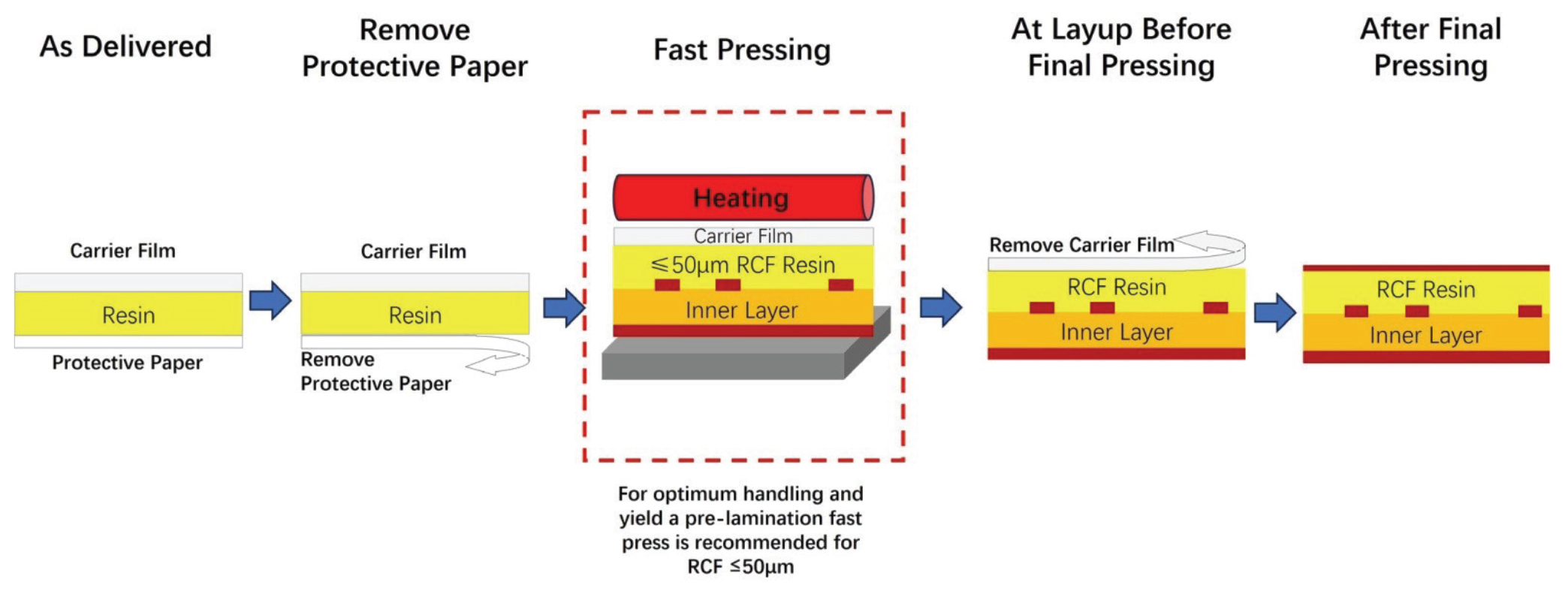
Press Parameters
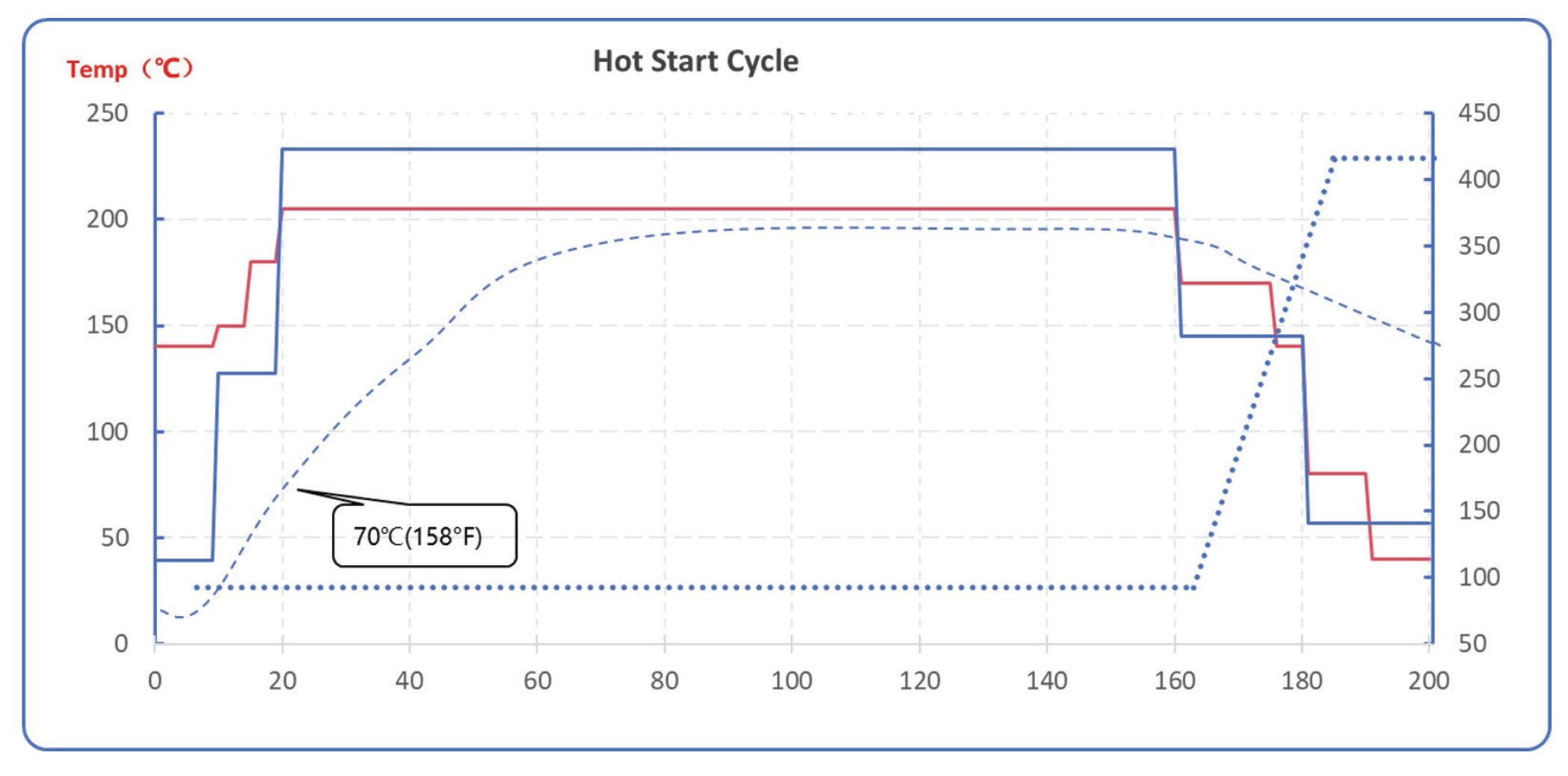
1. Heating rate (Rate of Rise) of material [Material Temperature]: Programmable Press:≥3.0ºC/min(5ºF/min ManualPress:3~6ºC/min(5~10ºF/min)
2. Curing Temperature& Time:>90min at more than 190ºC(374ºF) [Material Temperature].
3. Full Pressure: ≥420psi. It’s a guideline that full pressure is started before70ºC of material temperature.
4. Vacuuming should be continued until over 140ºC(284ºF)[Material Temperature]
5. Cushion for Pressure evenness is needed. (Sheets of kraft paper etc.)
Typical Drilling Conditions
Diameter (mm) Spindle Speed (KRPM) Feed Rate (m/mm) Retract Rate (m/mm) Hit Count 0.15 75 1 7.6 250 0.20 73 2.5 7.6 300 0.30 75 2.7 7.6 400 0.40 75 2.8 10.2 500 0.50 70 2.8 25.4 500 1. Drilling parameters should be adjusted depending on hole size, layer count, panel thickness, stack count and stack height etc; 2. Please adjust drilling parameters after checking qualities of through holes; 3. Entry board FR4 30mil; Exit board FR4 20mil;1panel/Stack
Desmear Process
If panels have been exposed to moisture, bake the boards at 105ºC-120ºCfor one or more hours to drive out moisture. The desmear Plasma time is typically half that of standard FR4/epoxy times because VT-8728G2 RCF resin system tends to etch back very quickly. Permanganate desmear IS NOT RECOMMENDED and has been shown to be very aggressive on VT-8728G2 RCF resulting in excessive etchback. This is due to the high silica filler content and thermoset content in the resin system.
 粤公网安备 32050502000822号